
.png)
Kassow Robots
Kassow Robots – Collaborative Solutions for Industrial Automation
In modern industrial automation, flexibility, precision and the ability to quickly adapt to new processes are becoming increasingly important criteria when choosing a robotic solution. In this context, Kassow Robots provide a solution for companies looking to automate repetitive operations and integrate collaborative robots into their production processes.
Developed for industrial applications and human–robot collaboration, Kassow Robots combine a compact design with flexible kinematics and the ability to be integrated into a wide range of applications.
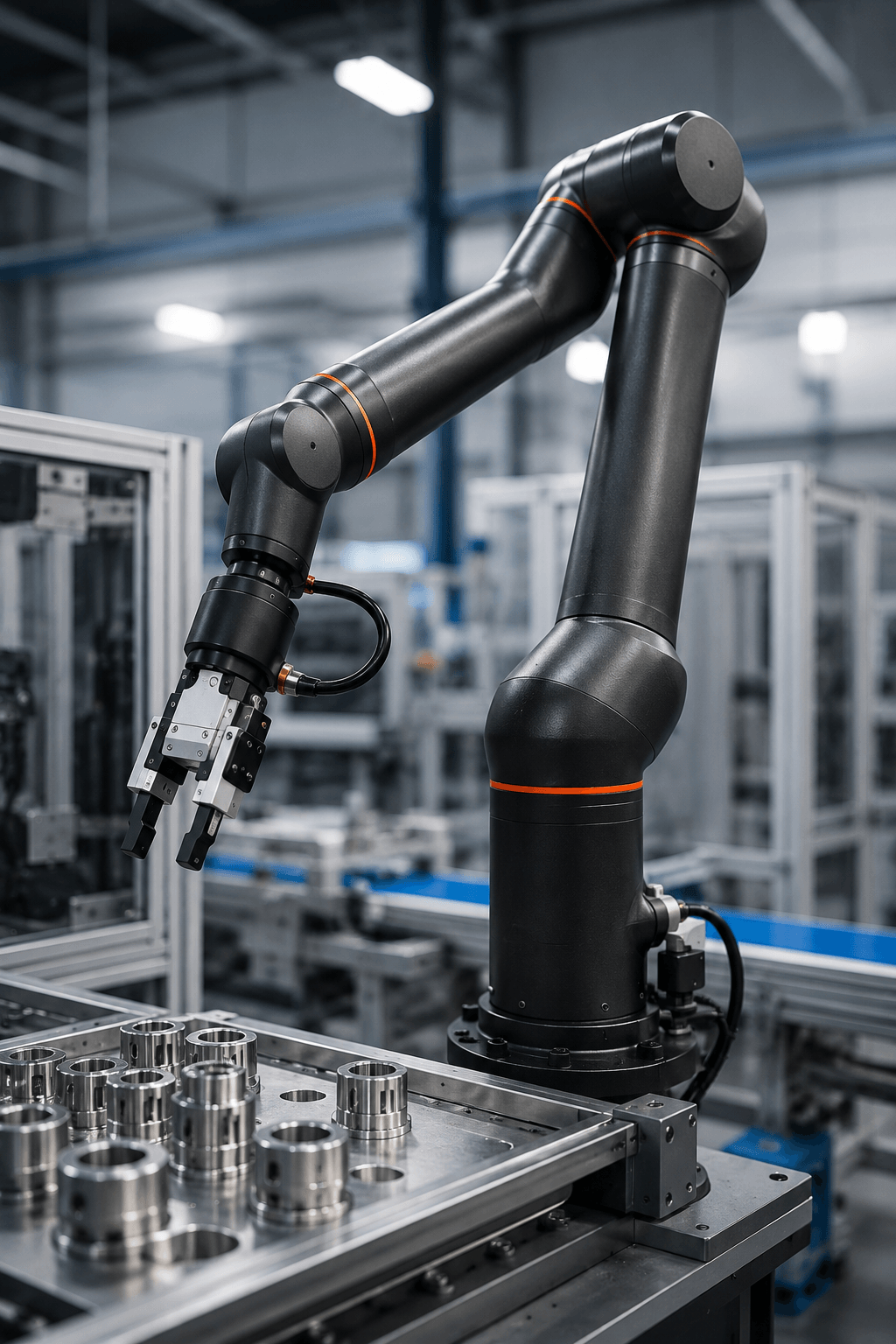
One of the distinctive features of the Kassow Robots range is its 7-axis architecture, which provides an additional degree of freedom compared with conventional 6-axis industrial or collaborative robots. This feature enables complex movements and access to difficult positions, making it particularly useful in confined workspaces.
By integrating Kassow Robots into complete automation solutions, they can be combined with gripping systems, sensors, cameras, conveyors, workstations and other industrial equipment.
Why are Kassow Robots an interesting solution?
The 7-axis architecture provides greater freedom of movement, which can facilitate robot integration in applications where the available space is limited, trajectories are complex or working positions are difficult to access.
What you will learn in this article
What are Kassow Robots and what makes them different?
The Kassow collaborative robot concept, its 7-axis design and the features that distinguish this architecture.
7-Axis Kassow Robots – Flexibility in Motion
Why the seventh axis matters and how it can help in applications with limited space or complex trajectories.
Industrial Applications for Kassow Robots
Pick & Place, Machine Tending, palletizing, handling, assembly, machine loading and other automated processes.
Integrating Kassow Robots into an Automation System
Integration with grippers, sensors, vision systems, conveyors, workstations and control systems.
How to Choose the Right Kassow Robot for Your Application
Payload, reach, cycle time, available space, precision, end-effector and the specific requirements of the industrial process.
What are Kassow Robots and what makes them different?
Kassow Robots are industrial collaborative robots developed for applications where flexibility, freedom of movement and integration into compact workspaces are important requirements. A defining feature of the range is its 7-axis motion architecture, designed to provide an additional degree of freedom compared with conventional 6-axis configurations.
The seventh axis allows the robot to change the configuration of its arm without necessarily changing the final position and orientation of the tool. In practice, this additional freedom can help the robot avoid obstacles, operate in confined spaces and access difficult-to-reach positions.
For this reason, Kassow Robots can be used in applications where the motion path is just as important as the final position: handling, machine loading, Pick & Place, assembly, quality control, palletizing and other automated processes.
7 Axes for Greater Freedom of Movement
A conventional industrial robot frequently uses 6 axes to control the position and orientation of the end-effector. Kassow Robots add a seventh axis, providing an additional degree of freedom.
This configuration enables more flexible trajectories and can facilitate robot integration into cells where equipment, structures, machines or other elements restrict the available space.
What makes Kassow Robots different?
In addition to the 7-axis architecture, the Kassow range is designed to combine reach, payload and flexibility in a format suitable for collaborative and industrial automation applications.
7 Axes
Additional freedom of movement for complex trajectories and difficult-to-access positions.
Compact Design
The slim arm configuration facilitates integration into production environments where the available footprint is limited.
Reach
The range includes configurations for compact applications as well as models with extended working reach.
Flexible Integration
The robots can be integrated with grippers, vision systems, sensors and other peripherals to create a complete application.
Models for Different Reach and Payload Requirements
The Kassow Robots range includes several configurations, allowing the robot to be selected according to reach, payload and the specific requirements of the process.
The current portfolio includes models such as KR810, KR1018, KR1205, KR1410, KR1805, KR1240 and KR1824, each retaining the characteristic 7-axis architecture.
From Compact Applications to Higher-Payload Handling
850 mm reach
10 kg payload
1000 mm reach
18 kg payload
1400 mm reach
10 kg payload
1800 mm reach
24 kg payload
Flexibility is the Main Advantage of the Kassow Architecture
By combining 7 axes with different reach and payload configurations, Kassow Robots can be adapted to a wide range of industrial applications. However, selecting the right model should start with the payload, workspace geometry, robot trajectory and the operation that needs to be automated.
7-Axis Kassow Robots – Flexibility in Motion
One of the defining characteristics of Kassow Robots is their 7-axis motion architecture. This design provides an additional degree of freedom and enables movements that can be difficult to achieve with a conventional 6-axis robot.
This advantage becomes particularly relevant when the robot must be integrated into an industrial cell where the available space is limited, obstacles are present or the working area must be accessed from a specific angle.
Instead of designing the entire cell around the robot's movement, the additional kinematic flexibility can allow the robot trajectory to be adapted to the process layout.
What Does the Seventh Axis Add?
Six degrees of freedom are required to position an end-effector in space. By introducing an additional axis, Kassow Robots benefit from kinematic redundancy.
In practice, the robot can use several arm configurations to reach the same tool position and orientation. This provides more options when calculating the trajectory required for an operation.
The result is greater freedom when designing the motion, especially in applications where the robot must work around other equipment or inside difficult-to-access areas.
Why Does 7-Axis Flexibility Matter?
The advantage is not simply the number of axes, but how this additional freedom can be used in the real application.
Obstacle Avoidance
The arm can adopt different configurations to follow trajectories around elements already present in the work cell.
Confined Spaces
Kinematic flexibility can facilitate robot integration into compact cells and areas with limited freedom of movement.
Difficult Access
The robot can approach specific working points from different configurations depending on the geometry of the application.
Complex Trajectories
The additional degree of freedom provides more options for configuring the trajectory between different working points.
More Possibilities for the Same Working Position
One of the advantages of a kinematically redundant system is the ability to change the position of certain joints while the end-effector remains in the position and orientation required by the process.
This behavior can be useful when the robot must maintain the orientation of a gripper, tool or component while adapting its configuration to the available workspace.
For the integrator, this means more options for configuring efficient motion within the cell.
One Additional Degree of Freedom
The seventh axis gives the robot more options for configuring the arm while performing the same positioning task.
Machine Tending in a Compact Workspace
Consider an application where a robot must pick up a component, place it inside a machine and, once the operation is complete, remove it and position it in another area.
Machine doors, panels, protective structures, conveyors or other equipment may be located around the robot. In such a situation, the flexibility of the 7-axis architecture can provide more possibilities for configuring the path between process points.
The same principle can be relevant in handling, assembly, feeding, inspection or Pick & Place applications.
7 Axes Mean More Than Flexibility – They Also Provide More Integration Options
In an automation project, the robot must be analysed together with the entire process. Mounting position, reach, payload, end-effector, obstacles and working points all influence the final configuration.
From this perspective, the kinematic flexibility of Kassow Robots provides integrators with more options when designing the cell and robot trajectories.
7-Axis Flexibility Must Be Used in the Right Application
The 7-axis architecture is one of the main features that differentiate Kassow Robots. Its real advantage appears when this additional freedom is used to solve specific access, positioning and integration requirements within an industrial process.
Industrial Applications for Kassow Robots
The kinematic flexibility of Kassow Robots enables their integration into a wide range of industrial processes, from repetitive handling operations to machine tending, assembly, palletizing and quality control.
However, selecting the application does not depend on the robot alone. To create an automated cell, the handled product, payload, reach, cycle time, available space, gripping system and interaction with other equipment must all be analysed.
Depending on the process, the robot can be integrated with grippers, vacuum systems, sensors, cameras, conveyors, workstations and control systems, creating a complete automation solution.
What Processes Can Be Automated with Kassow Robots?
Pick & Place
Automatic picking, moving and positioning of parts between process points.
Machine Tending
Automatic machine loading and unloading and robot integration into the production cycle.
Palletizing
Picking products and positioning them according to the defined pallet configuration.
Assembly
Handling and positioning components during different stages of assembly processes.
Handling
Automatic transfer of components between conveyors, workstations and other industrial equipment.
Inspection
Positioning cameras, sensors or components for automatic inspection and control operations.
Automatic Component Handling
In a Pick & Place application, the robot picks up a part from a defined position and transfers it to the next stage of the process.
The 7 axes of Kassow Robots can be useful when the robot must move around other equipment or access multiple positions within a compact space.
The end-effector can be configured according to the product using mechanical, pneumatic, electric or vacuum-based solutions.
02. Component picking
03. Controlled movement
04. Product orientation
05. Positioning
06. Component release
Automatic Machine Loading
Machine Tending involves using the robot to load a machine with parts and, once the operation is complete, remove the product and transfer it to the next stage.
The robot can communicate with the machine and execute the work sequence according to the current process status.
Kinematic flexibility is especially relevant when access to the loading area is limited or when the robot serves several positions within the same cell.
Product Handling at the End of the Process
Collaborative robots can also be integrated into palletizing and depalletizing applications, where products must be picked from one area and positioned according to a defined pattern.
Depending on the application, the robot can work together with a conveyor, detection system and an end-effector configured for the type of packaging or product being handled.
Selecting the Kassow model should take into account product weight, required reach, working height and pallet configuration.
Integrating the Robot into Workstations
In assembly processes, Kassow Robots can be used for handling and positioning components or for performing operations with a tool mounted on the robot.
The robot can be integrated into a workstation together with feeding systems, fixtures, sensors, control equipment and other process components.
In this type of application, motion repeatability and the ability to adapt the trajectory are important for maintaining a stable process.
The Robot as Part of the Inspection System
Another application is robot integration into inspection, measurement and quality control processes.
Depending on the process, the robot can position the product in front of an inspection system or move a camera or sensor to different areas of the component.
Vision Systems
Cameras for identifying or inspecting components.
Sensors
Integration of measurement and detection into the robotic sequence.
Positioning
Controlled movement to multiple inspection points.
The Application Defines the Robot Configuration
Handled weight
Required working area
Operation time
Required movement
Product interface
The Robot Should Be Selected Based on the Process, Not the Other Way Around
Pick & Place, Machine Tending, handling, assembly, palletizing and inspection are just some of the processes in which Kassow Robots can be integrated. To achieve an efficient solution, the robot, end-effector, control systems and peripheral equipment must be configured according to the specific requirements of the industrial application.
Integrating Kassow Robots into an Automation System
A collaborative robot does not operate in isolation. For Kassow Robots to perform an industrial operation efficiently, the robotic arm must be integrated with the other components of the process: gripping systems, sensors, control equipment, conveyors, vision systems and the machines with which it must interact.
For this reason, designing a robotic application starts with the process, not simply with selecting the robot model. Working points, trajectories, required signals, product gripping, machine interaction and safety requirements all need to be defined.
The result is a cell in which the robot, peripherals and automation operate together as one integrated system.
The Robot Is Only One Component of the Application
To pick up a component, the robot needs an end-effector. To identify the position of the product, the application may require sensors or a vision system. To communicate with a machine, signals and control logic must be integrated.
For this reason, application performance depends on how all these elements are selected and integrated together.
What Can a Robotic Cell Include?
The final configuration differs from one process to another, but most applications combine several of the following technologies.
End-effector
Mechanical, electric, pneumatic or vacuum grippers, or tools adapted to the operation.
Sensors
Product detection, position verification and process-state monitoring.
Vision Systems
Identification, localization, orientation or inspection of components before and after handling.
PLC and Control
Coordination of the robot with machines, sensors and other process equipment.
Conveyors
Feeding and removing products from the robot's working area.
Safety
Sensors, protective systems and safety logic configured according to the application's risk assessment.
Selecting the End-Effector Is Essential
The robot performs the movement, but the actual contact with the product is made by the end-effector.
Its selection depends on the shape, material, weight and sensitivity of the component. Some applications may require only an electric gripper, while others may need vacuum, pneumatic systems or specially designed devices.
The weight of the end-effector must be considered together with the weight of the product when selecting the required robot payload.
The End-Effector Should Be Selected According To:
✓ product geometry
✓ component weight
✓ surface material
✓ product orientation
✓ cycle time
✓ operation performed
Integrating Vision Systems
In applications where products do not always arrive in exactly the same position, a vision system can provide the information needed to identify and locate them.
A camera can detect the position or orientation of a component, and this information can be used to adapt the robot's movement.
Vision systems can also be used for product verification, reading markings, inspection or quality control.
The Robot Must Communicate with Process Equipment
In Machine Tending, assembly or transfer applications, the robot must be synchronized with the other equipment. A machine must be able to signal that it is ready for loading, that the operation is complete or that the product can be removed.
Depending on the application architecture, communication can be implemented through digital signals, PLC control or the industrial network used in the installation.
This allows the robot and machine sequences to become part of the same automated production cycle.
Integrating the Robot with Transport Systems
In many applications, products reach the robotic cell via a conveyor or transfer system.
Sensors can detect the arrival of the product, the transport system can stop and position it, and the robot then performs the required operation.
Once the sequence is complete, the product can automatically continue to the next stage of the process.
Safety Integration Must Be Analysed for Every Application
The fact that a collaborative robot is used does not mean that every application can operate automatically without additional protective measures.
Safety must be evaluated at the level of the entire application, taking into account the robot, end-effector, handled product, speeds, surrounding equipment and the way operators interact with the cell.
Risk Assessment
Evaluation of hazards resulting from the complete robotic process.
Safety Equipment
Sensors and protective systems configured according to the application.
Operator Interaction
Defining how people can work or intervene in the robot's operating area.
From Robot to Complete System
Defining the operation
Reach and payload
Product interface
Equipment communication
Application protection
Integration Turns the Robot into an Industrial Application
The performance of an application using Kassow Robots depends not only on the characteristics of the robot, but also on how it is integrated with the end-effector, control systems, sensors, conveyors and process equipment. The complete system must be considered, from analysis and engineering through programming, testing and commissioning.
How to Choose the Right Kassow Robot for Your Application
Selecting a Kassow Robot should start with the process that needs to be automated. It is not enough to consider only payload or reach; the entire application context must be analysed.
Product and end-effector weight, distances between working points, cycle time, available space and integration with other equipment are essential criteria when selecting the right configuration.
Main Selection Criteria
Total handled load
Required working reach
Cell geometry
Required productivity
Process equipment
Kassow Robots for Industrial Automation
With a flexible 7-axis architecture and different reach and payload configurations, Kassow Robots can be integrated into handling, Machine Tending, Pick & Place, assembly, palletizing and other industrial processes.
Do You Want to Automate a Process with Kassow Robots?
The CreatX team can help you identify the right configuration and integrate the robot into your industrial process.
Talk to the CreatX TeamRelated posts
-
 Aluminum Profiles
Discover the advantages of Bosch Rexroth aluminum profile systems for building modular, durable and highly adaptable...Read more
Aluminum Profiles
Discover the advantages of Bosch Rexroth aluminum profile systems for building modular, durable and highly adaptable...Read more
Leave a comment