


Industrial Aluminium Profiles vs. Standard Sections: Differences and Applications
Industrial Aluminium Profiles vs. Standard Sections: Differences and Applications
When building a machine frame, workbench or supporting structure, the choice of profile affects both construction and the scope for future modifications. Although they share the same base material, industrial aluminium profiles and standard sections can meet different requirements for assembly, integration and use.
In this comparison, industrial profiles means modular profiles with mounting slots, used with compatible connectors and accessories. By standard sections we mean shapes such as square or rectangular tubes, angles and U-channels. The distinction concerns the construction system: standard sections are also used in industrial applications.
This article examines differences in design, joining methods, stiffness and flexibility between the two options. It also explains what to consider when choosing a suitable solution, from structural loads to assembly time and total project cost.
A modular slotted profile is not automatically stronger than a standard section. Structural behaviour depends on cross-sectional geometry, alloy, span between supports, loads and joints. The benefits of modularity must be assessed alongside the project's mechanical and economic requirements.
1. What are industrial aluminium profiles and standard sections?
The main difference between the two categories considered here is how they are designed to form a structure. Slotted industrial aluminium profiles are part of a modular assembly system, whereas standard sections can be machined and joined to suit the project.
1.1. Industrial profiles with mounting slots
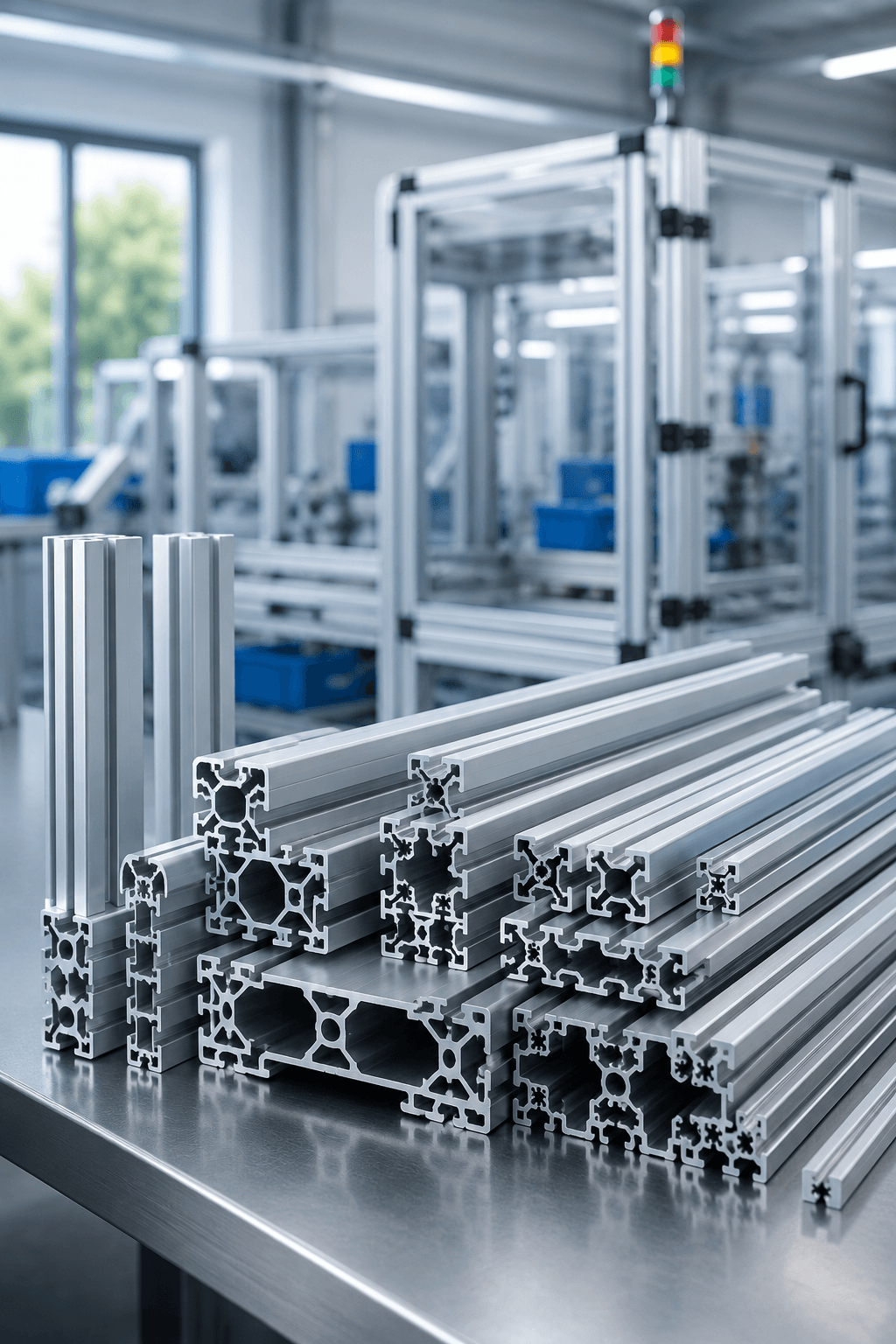
These profiles have longitudinal slots for attaching compatible connectors and accessories. They are used for machine frames, workstations, guards and other assemblies where mechanical fastening and adaptability matter.
- Mounting slots: accept suitable nuts and fastening elements.
- Dedicated accessories: brackets, connectors, hinges, adjustable feet and panel supports.
- Modular construction: allows profiles to be combined using detachable joints.
1.2. Standard aluminium sections
In this comparison, the category includes square and rectangular tubes, angles and U-channels. They are used for supports, frames and other structures, with joining methods selected according to geometry, alloy and loads.
Standard sections can be drilled, cut or machined to attach components. Depending on the project, joints may use bolts, connecting plates, rivets or welding, where the material and technical conditions permit.
Both categories can be used in industry. This comparison concerns the difference between a modular system with compatible accessories and construction based on conventional sections, rather than a general ranking of quality.
2. Differences in design and joining options
Profile geometry affects both mechanical behaviour and assembly. Modular profiles include slots and features intended for connections, while attachment points on standard sections are determined during design.
2.1. Joining modular profiles
In a modular system, connections can use external brackets, internal connectors or other dedicated elements. Depending on the chosen solution, profile ends may require drilling, tapping or other machining.
- Mechanical assembly: the structure can be assembled without welding, using the system's connectors.
- Flexible positioning: certain accessories can be moved along the slots before being secured.
- Disassembly: accessible joints may allow elements to be replaced or repositioned.
2.2. Joining standard sections
Assembly of standard sections may require holes, connecting plates or fasteners designed for the configuration concerned. A bolted structure can remain detachable, while a welded structure requires different operations to modify it.
The method must account for assembly access, wall thickness, joint loads and required accuracy. Welding aluminium requires checking the alloy and the process's effect on the properties and geometry of the assembly.
2.3. Compatibility of mounting components
Two modular profiles with the same external dimensions are not automatically compatible with the same accessories. Slot shape and size, profile series and connection requirements must be checked before assembly.
A stiff profile alone does not guarantee a stiff frame. Connector type, contact surfaces, fastening and any bracing affect assembly behaviour. Follow the installation instructions and specified tightening torques for the components used.
3. Strength, stiffness and sizing criteria
Comparing industrial aluminium profiles with standard sections requires considering cross-sectional properties and actual loads. External dimensions or weight per metre alone are not enough to determine which option is suitable.
3.1. The difference between strength and stiffness
Strength concerns the ability to withstand loads without exceeding the material's permissible limits. Stiffness describes resistance to deformation. A structure may support a load without damage yet deflect too much for the application.
For a workbench, deflection can affect surface flatness. In an automation frame, it can influence component alignment and device positioning. Verification must therefore cover both stresses and permissible displacements.
3.2. Which parameters should be assessed?
- Cross-sectional geometry: material distribution, wall thickness and relevant geometric properties.
- Alloy and material temper: the declared mechanical properties of the profile used.
- Span between supports: the distance over which the profile must carry the load.
- Loading type: bending, compression, torsion and combinations of these.
- Restraint conditions: joints, anchors, stiffening elements and support arrangements.
- Operating conditions: static loads, repeated movements, vibration or impact.
3.3. Assess the profile together with the structure
A standard tubular section may suit one frame, while a modular profile may provide the assembly benefits needed for another project. A sound comparison uses the technical data of the selected versions and checks the assembly, including its joints.
Two 45 × 45 mm profiles may have different internal geometries and properties. Check the data sheet, cross-section orientation and loading conditions before selection. Load-bearing structures require sizing calculations appropriate to the application.

4. Accessories, modularity and structural modifications
One advantage of slotted industrial aluminium profiles is the ability to integrate accessories without redesigning every attachment point. Slots provide mounting positions for compatible components and can make it easier to adapt the structure to new requirements.
4.1. Which accessories can be fitted?
- Panels and enclosures: panel supports, seals and fastening elements.
- Doors and access: hinges, handles, stops and locking systems.
- Support and mobility: adjustable feet, base plates and castors sized for the assembly.
- Workstation organisation: tool holders, lighting and cable-routing components.
- Equipment integration: brackets and supports for sensors or other components.
4.2. Adapting and extending a modular assembly
On a workstation, the position of a shelf or support can be changed by repositioning its fasteners, where access and design allow. Some nuts can be inserted through the slot opening, while others require access from the profile end.
Extending the frame or adding equipment requires checking the new loads. Modularity makes modification easier but does not remove the need for sizing and stability verification.
4.3. How can structures made from standard sections be adapted?
Standard sections also allow accessories to be fitted using holes, clamps, brackets or dedicated plates. Flexibility depends on the design: a mechanically fastened structure may be easier to adapt than one with permanently fixed elements.
A cable support and a structural connector have different requirements. Check profile compatibility and permissible load. For machine guards, the assembly must meet application requirements; simply fitting a panel to a frame does not establish its protective function.
5. Applications: when should you choose each option?
Choosing between slotted industrial aluminium profiles and standard sections depends on the construction requirements. Relevant factors include loads, assembly method, required accessories and the likelihood of future modifications.
5.1. When are modular profiles suitable?
Modular profiles are worth considering when a structure needs to integrate several components or remain adaptable. Mounting slots and compatible accessories can simplify building and adjusting the assembly.
- Workstations: tables, shelves and supports configured to suit the process.
- Automation frames: structures for mounting sensors, fixtures and equipment.
- Enclosures and perimeter guards: assemblies with panels and doors designed to meet application requirements.
- Prototypes and test stands: structures that may require repositioning or extension.
5.2. When might standard sections be suitable?
Tubes, angles and U-channels can be a justified choice for frames, brackets or supports with a defined geometry and few accessories. They are also useful when a project specifies particular machining and joining operations and reconfiguration is not an important requirement.
A project may use modular profiles in areas requiring adjustment and standard sections elsewhere. Connection compatibility, stiffness and the behaviour of the entire assembly must be checked regardless of the combination selected.
6. Total cost and selecting the right profile
Price per metre is only part of a structure's cost. For a meaningful comparison, both options must be assessed for the same function, loads and operating requirements.
6.1. What contributes to project cost?
- Materials: profiles, connectors, fasteners and accessories.
- Machining: cutting, drilling, tapping and other necessary operations.
- Assembly: installation, adjustment and inspection time.
- Finishing: treatments and operations required by the project.
- Future modifications: adaptation, disassembly and the potential to reuse components.
A modular solution may reduce certain machining operations and facilitate adaptation, but it also includes the cost of dedicated accessories. For a simple structure with few joints and no planned modifications, standard sections may offer a more suitable total cost.
6.2. What information is needed for selection?
Prepare a sketch showing assembly dimensions, loads and their positions, support points and required accessories. Specify environmental conditions, permissible deflections and whether the structure will be moved or modified.
A quotation covering only aluminium lengths cannot be compared directly with one that includes cutting, connectors and accessories. Check what each option includes and what further work is needed to produce the finished assembly.
Conclusion: the right profile meets the project's requirements
The difference between slotted industrial aluminium profiles and standard sections primarily concerns the assembly system, accessory integration and adaptability. Strength and stiffness must be checked for each section and configuration.
The right choice follows from assessing the application and total cost. A modular frame may suit a reconfigurable workstation, while a structure made from standard sections can efficiently meet a fixed requirement.
Planning a structure made from aluminium profiles?
Explore the range of Bosch Rexroth aluminium profiles or send the CreatX Technology team your project sketch and requirements to request information about available components and a quotation.
Explore aluminium profiles Request a quotationRelated posts
-
 Aluminum Profiles
Discover the advantages of Bosch Rexroth aluminum profile systems for building modular, durable and highly adaptable...Read more
-
 Kassow Robots
Discover Kassow Robots and the advantages of 7-axis technology for industrial automation. Learn how they can be...Read more
-
 Aluminum Profile Accessories – How to Choose the Right Components for Industrial Structures?
Discover the main aluminum profile accessories, their role, and how to choose the right components for modular...Read more
-
 Industrial Aluminium Profiles: How to Choose the Right Profile for Every Application
Discover how to choose the right industrial aluminium profiles for your application. Learn the key selection criteria...Read more
-
 Bosch Rexroth Aluminum Profiles: How to Choose the Right Profiles and Accessories
Learn how to choose Bosch Rexroth aluminum profiles for machine frames, workstations and industrial guarding. Find...Read more
Leave a comment