


Industrial Aluminium Profiles: How to Choose the Right Profile for Every Application
Industrial Aluminium Profiles: How to Choose the Right Profile for Every Application
In machine construction, production lines and various technical structures, industrial aluminium profiles provide a flexible solution for creating modular structures adapted to the requirements of each application.
From machine frames and safety guards to workstations, technical stands and structures integrated into production lines, modular systems make it possible to develop solutions that can be configured, extended or modified when industrial processes require changes.
However, choosing a profile should not be based solely on its dimensions. Load capacity, required rigidity, structural geometry, connecting elements, accessories and operating conditions are just some of the factors that should be considered before designing a structure.
In this article, we examine the main criteria for selecting industrial aluminium profiles, the applications in which they can be used and how profiles, accessories and connecting elements can form a complete modular system.
Modularity makes it possible to create structures adapted to each application while providing the flexibility to modify or extend them when production requirements change.
Contents
- What are industrial aluminium profiles and where are they used?
- How do you choose the right industrial aluminium profiles?
- Aluminium profiles for machines, guards and modular structures
- Workstations and production lines built with aluminium profiles
- From an aluminium profile to a complete industrial solution
1. What Are Industrial Aluminium Profiles and Where Are They Used?
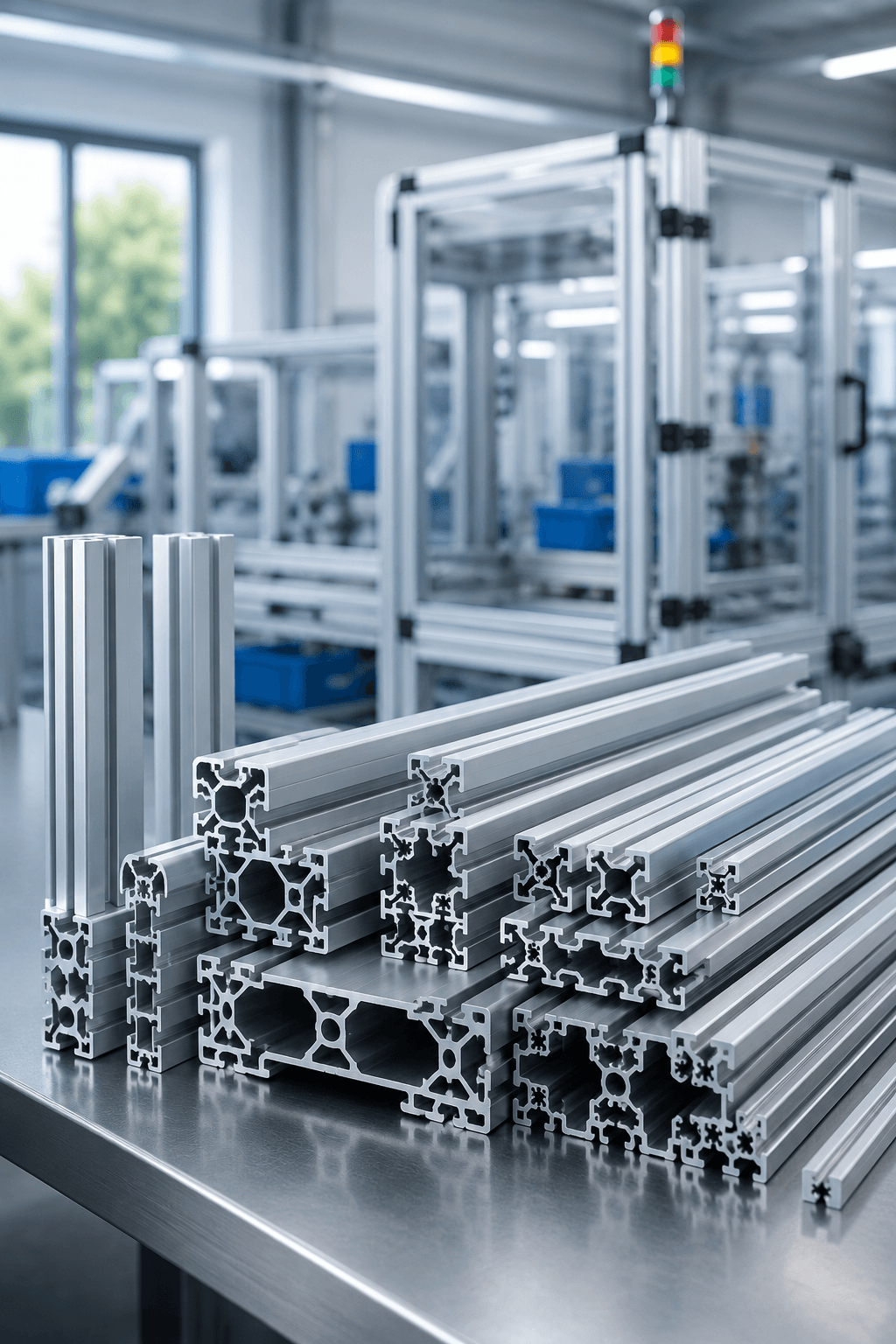
Industrial aluminium profiles are modular elements used to build technical structures for factories, machines and production lines. Their geometry allows profiles to be combined with connecting elements and accessories, enabling the final structure to be configured according to the requirements of each application.
Unlike structures manufactured using methods that involve permanent joints, modular systems allow components to be mechanically assembled. Depending on the project, this can simplify subsequent modifications, extensions or reconfiguration of the structure.
Profiles can be combined in numerous configurations and can be used to create anything from simple frames to complex structures integrated into production processes.
1.1. Where are industrial aluminium profiles used?
Thanks to their modular design, aluminium profiles can be used in a wide range of industrial applications, including:
- Machine frames: supporting structures for equipment, mechanisms and industrial components.
- Guards and enclosures: frames for panels and components used to separate machine working areas.
- Workstations: configurable structures for production, assembly and inspection operations.
- Production and assembly lines: structures used to organise and integrate different workstations.
- Equipment supports: frames for sensors, control devices, panels and other components.
- Transport and transfer structures: structural elements integrated into product handling and transport systems.
1.2. Why is aluminium suitable for modular structures?
Aluminium provides a favourable balance between weight and the mechanical properties required for many industrial structures. At the same time, extruded profiles can feature geometries specifically designed for integrating connecting elements and accessories.
A modular system allows a structure to be created without having to design every individual element from scratch. Profiles, connectors and accessories can be selected and combined according to the dimensions and requirements of the project.
A structure built with aluminium profiles can be designed so that certain components can later be repositioned, replaced or supplemented. This is particularly useful in production environments where machine and workstation configurations may change over time.
However, selecting the right profile is essential for the structure to meet the requirements of the application. Profile dimensions are only one criterion, alongside load, rigidity, geometry and the type of connecting elements used.
2. How Do You Choose the Right Industrial Aluminium Profiles?
Selecting the right industrial aluminium profiles should begin with the requirements of the final structure. Profile dimensions are important, but they are not the only factor that determines the appropriate configuration.
Supported loads, structural dimensions, support points, operating conditions and the equipment that will be installed should all be analysed before defining the final configuration.
2.1. The load the structure must support
One of the first criteria to consider is the load applied to the structure. This may result from the weight of installed equipment, handled parts or forces generated during machine operation.
The entire structure should be considered, as the distance between support points, profile orientation and connection method all influence the behaviour of the complete assembly.
2.2. Profile dimensions and rigidity
Profiles are available in different dimensions and geometries. Compact structures with relatively low loads may require a lighter configuration, while larger applications or structures subjected to higher loads may require profiles with greater rigidity.
Selection should therefore be based on the mechanical requirements of the complete assembly rather than solely on appearance or the external dimensions of the profile.
2.3. Type of industrial application
The required configuration can vary significantly depending on the purpose of the structure:
- A machine frame should be designed according to the dimensions and weight of the installed equipment.
- A machine guard should allow the integration of panels, doors and the required access elements.
- A workstation should be configured according to the operations performed and the positioning of equipment.
- A production line structure should consider integration with other stations and systems within the process.
2.4. Connecting elements and accessories
Profiles represent only one part of the system. The final configuration also depends on connectors, brackets, fastening elements, feet, castors, hinges, handles and other accessories used in the structure.
Correct selection of these components influences the assembly method, connection rigidity and the possibility of making future modifications.
2.5. Future modification and expansion
Requirements within an industrial environment can change. New equipment may be introduced, the configuration of a production line may change or a workstation may need to be extended.
For this reason, reconfiguration possibilities should be considered from the design stage. A well-designed modular system can make it possible to adapt the structure without completely rebuilding it.
Do not base your decision solely on profile dimensions. Consider the load, element length, support points, structural geometry, required accessories and the possibility of future expansion.
3. Aluminium Profiles for Machines, Guards and Modular Structures
One of the main applications for industrial aluminium profiles is the construction of structures around machines and production equipment. Their modular design allows the structure to be adapted to the dimensions and configuration of the application.
The same family of components can be used to develop frames, supports, guards or auxiliary structures, with the configuration determined according to the requirements of each project.
3.1. Machine frames and structures
Machine frames can be used to support mechanical components, electrical equipment, sensors, drive systems or other elements of an industrial installation.
The configuration should be determined according to equipment dimensions, supported loads and the position of the components to be installed. In certain applications, panels, doors or access elements may also need to be integrated.
3.2. Machine guards and enclosures
Aluminium profiles can form the frame of a machine guard or enclosure in which panels and other structural elements are integrated. Dimensions and configuration should be determined according to the machine and the requirements of the application.
The modular system makes it possible to create both fixed sections and movable elements, such as doors or access panels, using accessories compatible with the structure.
When designing a machine frame or guard, the profile should not be considered in isolation. Structural geometry, fixing points, panels, doors, accessories and the way the structure will be used all influence the final configuration.
3.3. Modular structures adapted to the production process
A modular structure can be developed around the requirements of the production process. Areas for installing equipment, component supports, work surfaces and mounting points for accessories can all be incorporated into the design.
When process requirements change, certain elements of the structure can be repositioned or supplemented, depending on how the original structure was designed.
This flexibility allows modular systems to be used both for new projects and for adapting specific areas of existing installations.
4. Workstations and Production Lines Built with Aluminium Profiles
Industrial aluminium profiles can also be used to create workstations and structures integrated into production and assembly lines. In these applications, modularity allows the structure to be configured according to the operations being performed and the equipment being used.
The design should consider both technical requirements and the way operators and equipment interact with the structure.
4.1. Configurable industrial workstations
A workstation can integrate work surfaces, shelves, tool holders, component bins, lighting equipment and other accessories required for production or assembly operations.
The configuration can be adapted to the type of activity and available space, while certain components can be repositioned when process requirements change.
4.2. Workstation ergonomics
When designing a workstation, the position of the work surface, access to tools and components, equipment placement and repeatedly performed operations should all be considered.
Correct organisation of these elements can support efficient operations and reduce unnecessary movement within the workstation.
4.3. Integration into production and assembly lines
Workstations and modular structures can be integrated into a production line together with automation equipment, handling solutions and industrial transfer systems.
In this case, the design should take into account the flow of parts between stations, operator positioning, equipment layout and the space required for production operations.
4.4. Adapting the structure when the process changes
Production lines can change during operation as new products are introduced, assembly stages are modified or additional equipment is integrated.
A modular structure can facilitate certain modifications because components can be dismantled, repositioned or supplemented without replacing the entire assembly.
When designing a workstation or production structure, it is useful to consider possible future expansion. Space for additional accessories and a modular configuration can simplify adaptation to new production requirements.
5. From an Aluminium Profile to a Complete Industrial Solution
Selecting suitable industrial aluminium profiles is only the first step in creating a structure. For the final result to meet the requirements of the application, the profiles must be integrated into a system in which sizing, connecting elements, accessories and the overall configuration are considered from the design stage.
An industrial structure should be designed according to the role it will perform within the process. A machine frame, workstation, guard or structure integrated into a production line will have different requirements in terms of rigidity, dimensions, accessibility and expansion possibilities.
5.1. Designing the structure according to the application
The process begins by identifying the technical requirements of the application. Available dimensions, loads, equipment to be installed and the way the structure will be used all influence the final configuration.
At this stage, both the required profile types and the position of support elements and connection points should be determined. Correct design makes it possible to create a structure adapted to the application while avoiding unnecessary complexity or overdimensioning.
5.2. Profiles, connecting elements and accessories
The advantage of a modular system lies in the ability to combine profiles with a wide range of connecting elements and accessories. This allows the structure to be configured according to project requirements and additional components to be integrated wherever the process requires them.
Depending on the application, connectors, brackets, feet, castors, handles, hinges, panels, fastening elements and other components required to create the complete assembly can be used.
5.3. Bosch Rexroth modular systems for industrial applications
For the construction of modular structures, Bosch Rexroth offers aluminium profile systems and components for assembly technology that can be used across a wide range of industrial applications.
These solutions can be used to develop machine frames, guards, workstations, production structures and other configurations adapted to the requirements of industrial processes.
The modularity of the system facilitates both the construction of new structures and their adaptation when application requirements change. Profiles, connecting elements and accessories can be combined to develop a complete solution based on the specific requirements of the project.
5.4. From individual components to a project-specific structure
In practice, the value of a modular solution is determined not only by the profile itself, but by how all components are integrated into a functional assembly.
Whether the project involves a machine frame, safety enclosure, workstation or structure for a production line, the design should begin with the final application and consider how its requirements may evolve over time.
By correctly selecting and configuring industrial aluminium profiles, a modular structure can be developed to meet both current process requirements and potential future modifications.
A modular solution should be considered as a complete assembly consisting of profiles, connecting elements, accessories and components adapted to the application. Correct design of the entire structure is just as important as selecting the profile itself.
CreatX Technology provides solutions for industrial applications based on Bosch Rexroth assembly technology, from selecting the appropriate components to developing a configuration adapted to the requirements of your project.
Whether you need a machine frame, modular structure, machine guard, workstation or a solution integrated into a production line, the CreatX Technology team can help you identify the right configuration for your application.
Send us your project details and discuss the right solution for your application with the CreatX Technology team.
Request a QuoteRelated posts
-
 Aluminum Profiles
Discover the advantages of Bosch Rexroth aluminum profile systems for building modular, durable and highly adaptable...Read more
-
 Kassow Robots
Discover Kassow Robots and the advantages of 7-axis technology for industrial automation. Learn how they can be...Read more
-
 Aluminum Profile Accessories – How to Choose the Right Components for Industrial Structures?
Discover the main aluminum profile accessories, their role, and how to choose the right components for modular...Read more
-
 Industrial Aluminium Profiles vs. Standard Sections: Differences and Applications
Discover the differences between industrial aluminium profiles and standard sections: joining methods, stiffness,...Read more
-
 Bosch Rexroth Aluminum Profiles: How to Choose the Right Profiles and Accessories
Learn how to choose Bosch Rexroth aluminum profiles for machine frames, workstations and industrial guarding. Find...Read more
Leave a comment