


Aluminum Profile Accessories – How to Choose the Right Components for Industrial Structures?
Aluminum Profile Accessories – How to Choose the Right Components for Industrial Structures?
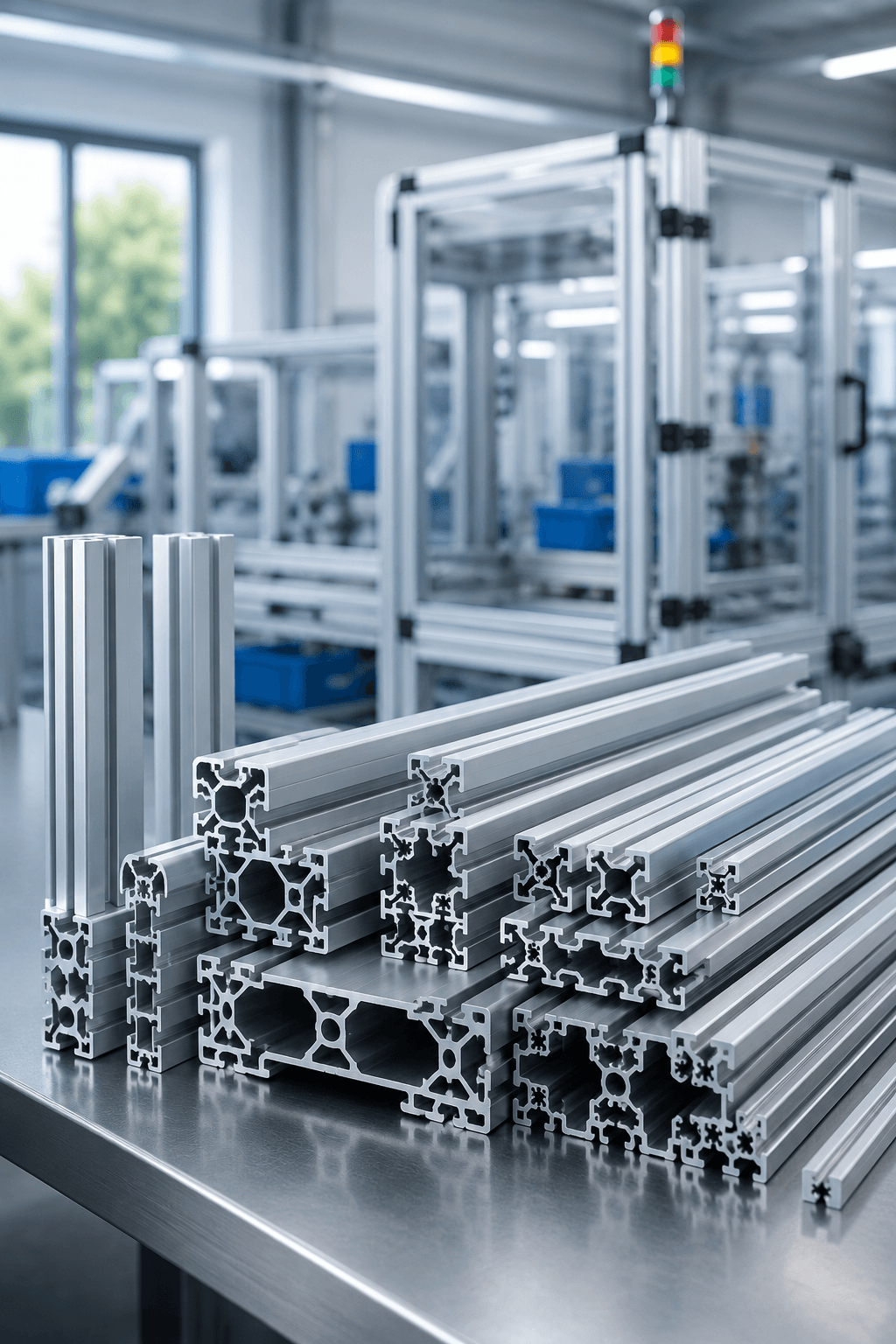
Aluminum profiles are used in a wide range of industrial applications due to their modularity and the possibility of building structures adapted to the requirements of each project. However, creating a complete structure depends not only on choosing the right profile, but also on correctly using different accessories for aluminum profiles.
Components such as connectors, brackets, nuts, fastening elements, end caps, support feet, hinges and handles allow modular structures to be assembled and configured for automation systems, production lines, workstations and many other industrial applications.
In this article, we examine the main types of accessories, their role and the criteria that should be considered when configuring an industrial structure using Bosch Rexroth aluminum profiles and accessories.
A modular aluminum profile system consists of more than the profiles themselves. Accessories make it possible to connect, fasten, support, protect and adapt the structure according to the industrial application in which it will be used.
What Are Aluminum Profile Accessories and What Is Their Role?
Aluminum profile accessories are components used to assemble, fasten and complete structures made from modular profiles. They make it possible to connect profiles together and adapt the structure according to the requirements of the industrial application.
Unlike welded structures, modular systems allow industrial structures to be built using mechanical connections. This means that the configuration can be modified, extended or reorganized when the production process or the equipment being used changes.
Choosing the right accessories influences not only how the structure is built, but also its stability, functionality and ability to be modified later.
Profiles form the basic structure, while accessories make it possible to create connections and integrate the elements required by the application. In practice, they transform individual profiles into a complete and functional modular system.
Connectors, brackets and joining elements make it possible to connect profiles in different positions and configurations.
Nuts, screws and fastening elements allow equipment and other components to be mounted directly onto the aluminum structure.
The modular system allows components to be added or repositioned when the structure needs to be adapted to a new application.
Feet, end caps, hinges, handles and other accessories complete the structure and allow it to be adapted to its final use.
The combination of aluminum profiles and modular accessories makes it possible to create structures that can be configured according to the application and modified later without having to completely rebuild the assembly.
What Are the Main Types of Aluminum Profile Accessories?
A modular structure may require numerous additional components depending on its dimensions, configuration and role within the industrial application. For this reason, the range of aluminum profile accessories includes joining and fastening elements as well as components for support, protection and access.
These accessories should be selected together with the profile being used and according to the requirements of the structure, so that all components form a compatible and functional assembly.
There is no single accessory suitable for every structure. The profile type, connection method, structural loads and components that need to be integrated determine which accessories are required for each project.
They are used to connect profiles and create different structural configurations. Depending on the project, these components make it possible to build frames, supports and other modular structures.
Profile slot nuts, screws and other fastening elements allow accessories or equipment to be mounted onto the aluminum structure.
They are used to support and position the structure. Depending on the configuration, they can help adapt the structure to the surface on which it is installed.
They allow doors, movable panels and access areas to be created for enclosures, protective structures, workstations and other industrial constructions.
End caps and protective elements complete the structure and can protect specific areas of the profile or assembly.
Depending on the application, the structure can integrate panels, equipment, sensors, automation elements and other components required by the industrial process.
One of the advantages of modular systems is that these components can be combined to create very different structures using the same profile family. This means that aluminum profile connectors, fastening elements and other accessories can be selected according to the specific requirements of the application.
When selecting industrial aluminum profile accessories, their compatibility with the series and dimensions of the profile being used must be checked. Correct selection simplifies assembly and contributes to creating a structure adapted to the requirements of the project.
How Do You Choose the Right Accessories for an Aluminum Profile Structure?
The correct selection of aluminum profile accessories should begin during the structure design stage. It is not enough for a component simply to fit the profile; it is also necessary to determine whether it is suitable for the configuration, dimensions and intended use of the assembly.
A simple structure designed to support equipment may have different requirements from a workstation, a machine guard or a frame integrated into an automated production line. For this reason, accessories should be selected according to the final application.
Before selecting the components, several essential criteria should be considered, as they can influence both the assembly process and the subsequent operation of the structure.
First, determine what the structure needs to do, which equipment it will support and whether future modifications may be required. Only then should the profiles, joining elements and necessary accessories be selected.
The profile dimensions, slot geometry and product family should be taken into account when selecting joining and fastening elements.
An equipment frame, workstation or machine guard may require different combinations of profiles, connectors and functional accessories.
The weight of the mounted components and the loads acting on the structure should be analyzed when selecting the appropriate profile and joining solution.
If the structure may need to be modified in the future, choosing a modular configuration makes it easier to add or reposition components.
The environment in which the structure will operate, operator access and integration with other equipment should be considered from the configuration stage.
Doors, panels, handles, support feet and other components should be selected according to how the structure will actually be used.
For example, in the case of a frame designed to support industrial equipment, the selection should begin with the equipment dimensions and weight. For a workstation, adjustment options and the integration of accessories required by the operator may become important. In the case of machine guarding, the configuration should be adapted to the panels, doors and access areas.
Profiles, connectors, fastening elements and accessories should not be selected separately. The correct approach is to configure them as a complete modular system adapted to the application and the requirements of the industrial project.
Where Are Aluminum Profiles and Their Accessories Used in Industry?
Thanks to their modular design, aluminum profiles and accessories can be used to create a wide range of industrial structures. The same technology can be used to configure simple support structures as well as integrate complex assemblies into production lines and automated systems.
The ability to combine profiles, joining elements and different accessories makes it possible to adapt the structure to the available space, installed equipment and requirements of the industrial process.
Modular aluminum systems can be configured for numerous applications, while the possibility of making future modifications also makes them suitable for industrial processes that evolve over time.
Modular profiles make it possible to configure workstations and integrate the elements required by operators and production processes.
Frames and support structures can be built for equipment, automation modules and various industrial components.
Profile structures can be used to build frames for panels and protective elements around machinery and industrial equipment.
Profiles and accessories can be integrated into the structures of assembly lines, workstations and production processes.
Modular structures can form part of industrial transport systems and support the components required to integrate conveyors into a production line.
Modular frames can support sensors, control elements, electrical equipment and other components used in industrial process automation.
If the industrial process changes, a modular structure can be extended or reconfigured by changing the position of profiles and accessories. This allows the structure to be adapted to new requirements without replacing the entire assembly.
Bosch Rexroth Profile and Accessory Systems – Configuring a Complete Solution
When an industrial structure is configured as a complete system, the selection of profiles must be coordinated with the joining elements and accessories required by the application. Modular systems allow these components to be combined to create a solution adapted to the project.
The range of Bosch Rexroth aluminum profiles and accessories can be used to create structures for automation, assembly technology, workstations and other industrial applications.
For a correct configuration, the geometry of the structure, profile dimensions, connection types, functional accessories and equipment to be integrated should all be considered together.
An efficiently configured industrial structure starts with the actual requirements of the application. The profiles and accessories are then selected to form a compatible, modular system adapted to the industrial process.
Define the role of the structure, the required dimensions, the equipment to be integrated and how the structure will be used.
Profiles are selected according to the structure configuration and the mechanical requirements of the application.
Compatible joining, fastening and support elements, together with the required functional accessories, are selected for the structure.
The structure is configured to allow equipment integration and adaptation to the rest of the industrial installation.
Choosing the right aluminum profile accessories contributes to creating a structure adapted to the application and makes it easier to integrate the components required by the industrial process.
By approaching profiles, joining elements and accessories as parts of the same system, the structure can be designed from the beginning to meet current requirements while remaining adaptable to future modifications.
Do You Need Aluminum Profiles and Accessories for Your Project?
CreatX provides Bosch Rexroth solutions for aluminum profiles, accessories and modular systems designed for industrial applications. We can help you identify the right components for the configuration and requirements of your project.
Contact CreatXRelated posts
-
 Aluminum Profiles
Discover the advantages of Bosch Rexroth aluminum profile systems for building modular, durable and highly adaptable...Read more
-
 Kassow Robots
Discover Kassow Robots and the advantages of 7-axis technology for industrial automation. Learn how they can be...Read more
-
 Industrial Aluminium Profiles: How to Choose the Right Profile for Every Application
Discover how to choose the right industrial aluminium profiles for your application. Learn the key selection criteria...Read more
Leave a comment